
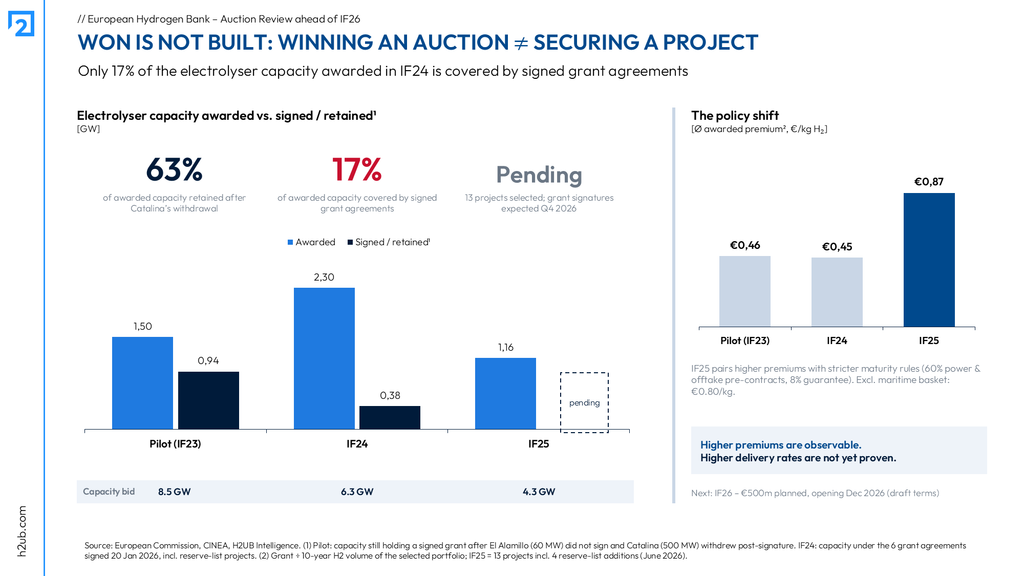
Winning a European Hydrogen Bank auction and building a hydrogen project are two different things. In the second auction, signed grant agreements cover only 17% of the electrolyser capacity originally awarded, even after reserve-list projects stepped in. That gap is worth keeping in mind, as the Commission prepares IF26. The fourth auction is planned to open in December with up to €500m, around 60% less than the €1.3bn offered in IF25.
The problem: Awards that do not hold
In the pilot auction, seven projects won €720m for 1.5 GW. El Alamillo (60 MW) did not sign, and the largest winner, the 500 MW Catalina project in Spain, handed back its grant after signing, citing tight deadlines and its dependence on a pipeline that has not reached financial close. About 0.94 GW, or 63% of the awarded capacity, still holds a signed grant. The second auction (IF24) went worse. Of the 2.3 GW awarded €992m, six projects signed in January 2026 for 381 MW and €270.6m, which is 17% of the awarded capacity and less than a quarter of the €1.2bn budget. The two figures measure slightly different stages: the pilot share reflects a withdrawal after signature, while the IF24 share is measured at signature.
Who dropped out is telling. The seven IF24 projects that withdrew, about 1.9 GW in total, had bid between €0.20 and €0.60/kg. The reserve-list projects invited in their place had bid €0.64 to €1.22/kg. After these withdrawals and replacements, the signed IF24 portfolio carries €0.71m of grant per MW, 65% more than the initially selected portfolio. Developers cited delayed national legislation (H2-Hub Lubmin), missed delivery milestones (Zeevonk) and dependence on infrastructure that does not yet exist (Catalina). This suggests that an auction that primarily rewards low premiums can favour optimistic assumptions over project readiness when prequalification requirements are insufficient. The completion guarantee does filter out, in the words of a Commission official, “companies that have bid too low”, but only after the budget has been tied up for months.
What changed in IF25
IF25 attracted 58 bids for 4.3 GW of electrolysis, requesting €8.4bn, more than six times the budget. The general RFNBO basket alone was twelve times oversubscribed. The Commission tightened maturity requirements, including pre-contracts for 60% of electricity supply and offtake, and opened a basket for low-carbon electrolytic hydrogen. Nine projects were selected in May, and four reserve-list projects were added in June. The 13 projects now in grant preparation account for about €1.24bn and 1.16 GW, producing around 1.43 Mt of hydrogen over ten years. That implies an average premium of about €0.87/kg (€0.80/kg excluding the maritime basket), compared with €0.45 to €0.46/kg in the first two rounds. The portfolios differ in composition, but the direction is clear: the EU is accepting higher premiums in exchange for stricter maturity requirements. Whether this translates into higher delivery rates remains to be seen. The first signal will come when grant agreements are signed, which the Commission expects in Q4 2026.
Two further observations stand out. First, the bid pool is shrinking: offered capacity fell from 8.5 GW in the pilot to 6.3 GW and then 4.3 GW. This could reflect stricter eligibility filtering out immature projects, tighter financing conditions or deteriorating project economics, and the data do not allow us to separate these explanations. Second, the maritime and aviation basket attracted only three bids worth €163m against €300m on offer. This is consistent with offtake data showing that these sectors have the lowest willingness to pay. The draft IF26 terms drop the basket altogether.
H2UB Perspective: What to Watch in IF26
Confirmed so far. The Commission plans a budget of up to €500m, with the call opening in December 2026 and closing in February 2027. Both budget and dates are still labelled as planned.
Draft terms, subject to change. Two baskets (€350m RFNBO, €150m RFNBO or low-carbon), a €4/kg ceiling and caps of €175m and €150m per project. The IF25 maturity rules carry over: at least 75% of electrolysers from outside China with no Chinese stacks in that share, signed heads of terms for 60% of offtake, contracts for 60% of the required electricity and an 8% performance guarantee. Member states wishing to add national money via Auctions-as-a-Service were asked to confirm by 1 November.
H2UB scenarios. At IF25 grant intensity, €500m supports roughly 0.4 to 0.6 GW before national top-ups. With maturity and origin rules unchanged, we do not expect a return to sub-€0.50 bids. BNEF puts 2025 alkaline system costs at around $536/kW in China and $2,385/kW in Europe, so the origin rule alone keeps the cost floor high. National money is likely to matter more than the headline budget: Germany and Spain added €1.7bn to IF25 via Auctions-as-a-Service, more than the EU’s own allocation.
Conclusion
The first Hydrogen Bank rounds produced headline prices that flattered the market. A €0.37/kg premium looked like proof that renewable hydrogen was close to competitive. In hindsight, many of these bids priced an option on a project rather than the project itself. IF25 and IF26 mark a shift from the cheapest bid towards the most deliverable one. For developers, this means that offtake, power supply and supply chain must be secured before bidding, not after winning. For policymakers, the meaningful measure of success is not euros per kilogram awarded, but verified hydrogen output per euro of public support, alongside the share of awarded projects that actually reach operation.
Sources: European Commission/CINEA, Hydrogen Europe, S&P Global Commodity Insights, H2 View, PNO Innovation, BNEF, H2UB Intelligence