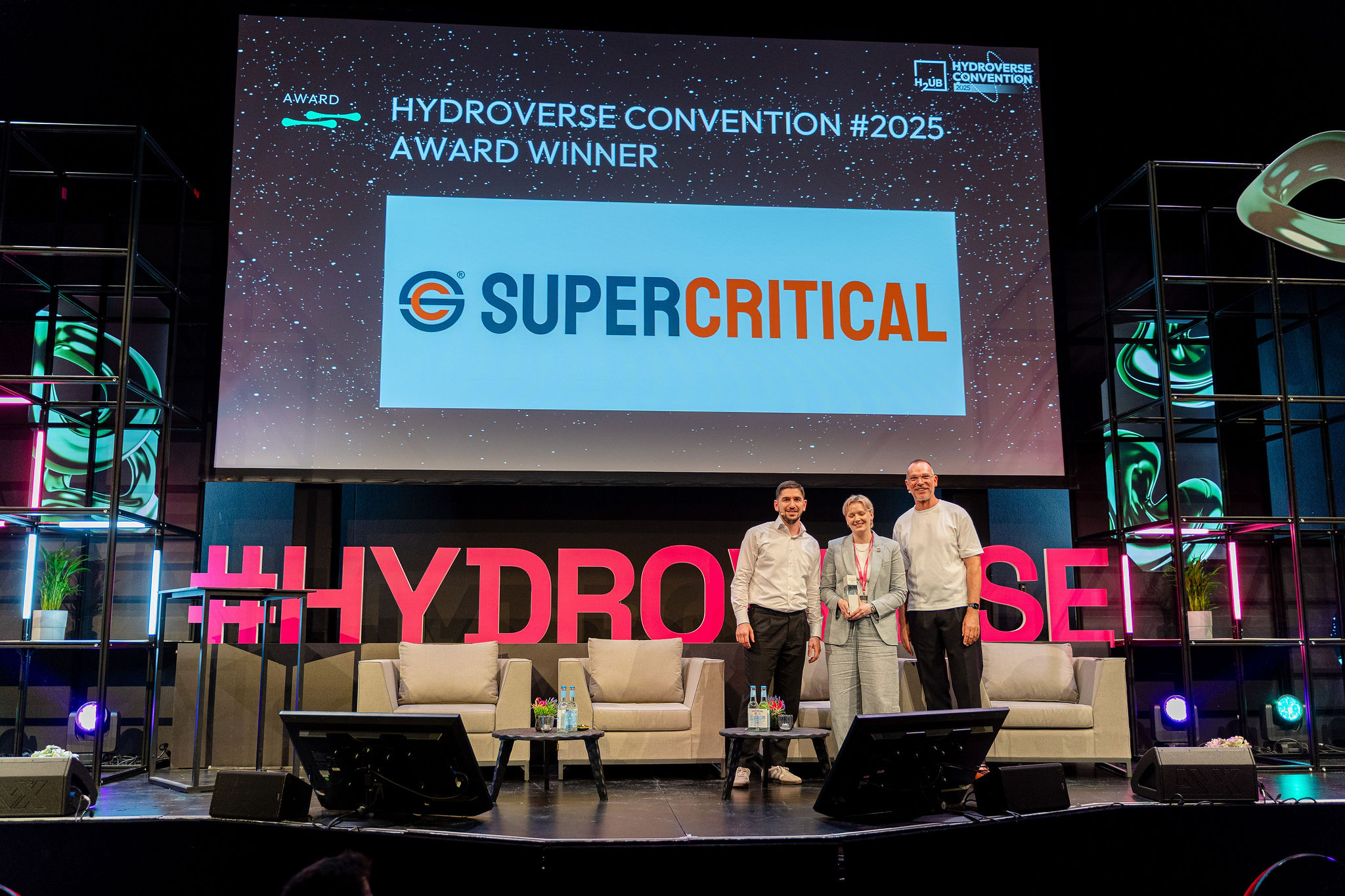
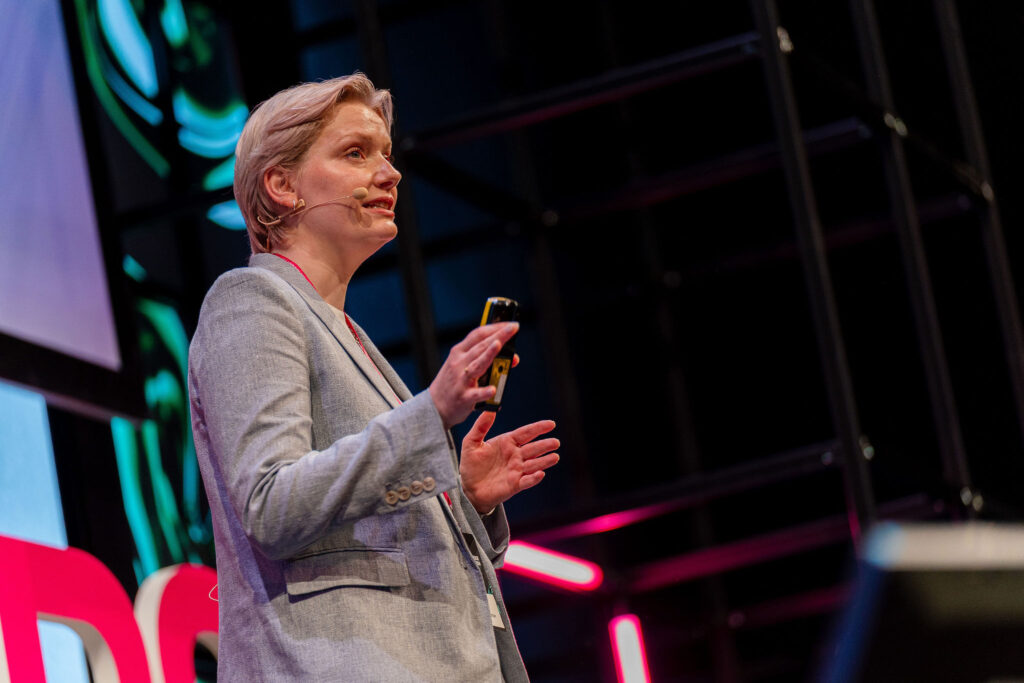
Supercritical Solutions is featured as part of our new series, where we highlight the success stories of start-ups in our #HYDROVERSE ecosystem. Following, CPO and Co-founder Luke Tan and Business Development Manager Dr. Abi Mountain jointly share insights into the start-up’s journey.
Abi, Luke, please pitch your start-up story.
Abi Mountain & Luke Tan: Supercritical was founded to solve some of the greatest issues facing the reduction of the cost of hydrogen, which is vital to de-fossilise key industries such as chemicals, fertilisers, shipping, and heavy industry. We’ve re-invented the water electrolyser, developing a completely novel architecture from scratch, rather than make incremental improvements on an incumbent technology.
What inspired you to found a company?
The main obstacles we saw to reducing the cost of hydrogen are the failure and supply chain risks of membranes, and the cost of compressing hydrogen, which is significant in 90% of the industries that rely on hydrogen at pressure. We sought to develop a technology solution to solve these problems and have engineered a novel, membrane-less electrolyser that outputs hydrogen at pressures up to 220 bar.
Which market or technological assumption did you need to reconsider in the process?
We reconsidered the assumption that electrolysis can’t take place at high pressures. Most electrolysers operate at ambient temperatures and pressures, requiring energy-intensive and costly multi-stage compressors downstream for high pressure end use cases or storage.
Supercritical’s technology operates at high pressure and high temperatures, which significantly increases the efficiency of the electrolysis reaction vs if carried out at ambient or even moderate conditions. At such high temperatures and pressures, a traditional membrane would lose structural integrity. To solve this, we have engineered a novel, membraneless design. Hydrogen production in our cells takes place via our proprietary porous, flow-through electrolysis process.
This unique design enables our high pressure and temperature conditions, which give us leading specific energy consumption and efficiency for the total system. These efficiency gains lower the biggest contributor to LCOH, which is electricity consumption, while our high pressure output eliminates the CAPEX and OPEX of compression downstream.
In what ways has participating in the H2UB program positively affected your start-up?
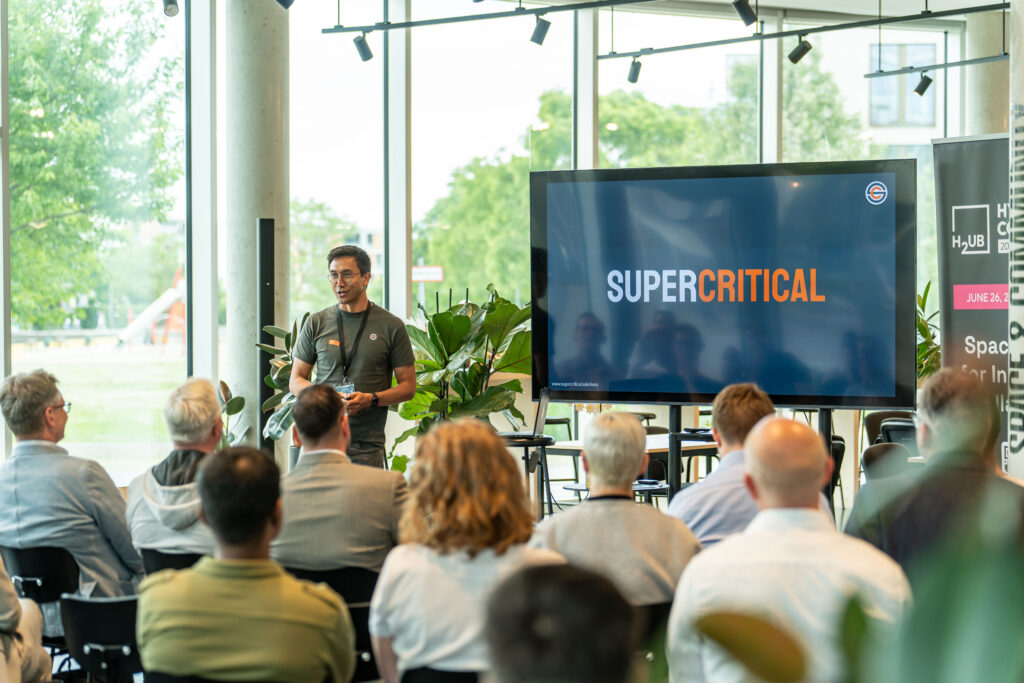
Engaging with industrial mentors was helpful in boosting our understanding of how both investors look at opportunities in the clean tech world, and in how project developers digest technology into project economics. Our commercial case certainly strengthened with the honest sessions where real time and energy was committed by the mentors.
What was your biggest success since participating?
We’re proud to announce two major commercial partnerships on our journey to pilot. One with the preeminent player in the sector, Shell, and a second with the long term hydrogen ecosystem player Valterra Platinum. This demonstrates that not only are our technical fundamentals strong, but that we can work with the complex and challenging procurement processes of some of the biggest organisations on the planet.
What did you gain from these collaborations?
We’ve entered into a non-exclusive paid collaboration agreement with Shell that will assess performance data analysis, process safety assessment and a techno economic evaluation of our pioneering technology. The findings will inform whether a pilot opportunity can be explored in the future. We also recently announced a paid pre-feasibility study on a pilot with Valterra Platinum.
Collaborating with global companies such as Shell and Valterra Platinum allows us to get the market validation we need to achieve the next steps in our commercialisation journey, and enables us to validate our performance data, process safety and technoeconomics.
Which part of our accelerator did you find most valuable?
The mentor sessions were the best we’ve ever been party to. The mentors genuinely showed up, really committed their time, and wanted to help. This was quite a fundamental shift from other accelerators we’ve been part of. It worked really well. The coaching for the pitch was also great, and ultimately helped us to go on and win Best Pitch at HYDROVERSE CONVENTION 2025!
Which piece of advice or situation do you remember most vividly?
We’ve built on one of the mentor conversations quite a lot – the topic was all about a project developer’s perception on technology and how that impacts the developer’s project economics. This was a really great insight from ‘the other side of the table’ in an environment where there were ‘no stupid questions’.
What needs to be done to further advance hydrogen and green energy innovations in the market?
Continuous innovation is key. Scaling is a major focus within the sector right now and while it’s very important, we need to keep feeding the funnel with exciting new ideas. We can’t afford to let green hydrogen become dormant. It’s too important a molecule for fuels, chemicals and all of their downstream products we use as consumers everyday.
What advice would you give to other founders who are just starting out in the hydrogen market?
There is plenty of room for great minds to tackle the issues surrounding hydrogen, renewables and the climate at large. Great minds are indeed part of the reason we’re facing environmental challenges now – the same people who have delivered us incredible advances over the past 200 years through industrialisation have also inadvertently caused downsides as well.
It’s the same great minds with new tools and new inventions that will solve our climate problems. We need to carefully target how we resolve problems. The scale of the challenge is daunting, but founders with clarity on which piece of the issue they’re best suited to take on can use their skills to solve their piece of the puzzle as best they can. It’s important to remember that economics drives decisions – make things better environmentally without making things more expensive and be clear on how this impacts your customers.
Don’t be afraid of collaboration but be careful with your IP – as a start-up, that’s often all you have.
What is your next big step?
The next step in our trajectory is to pilot our technology, demonstrating full balance of plant in an operational environment. Beyond our pilot projects, we will build up the capability to deliver commercial units, serving such demand from the end of the decade, and are exploring licensing arrangements as our partnerships develop.
Thank you, Abi & Luke!
About Luke Tan, Chief Product Officer and Co-founder
Luke is the Chief Product Officer at Supercritical, a company aiming to slash the cost of green hydrogen with the world’s first high pressure, ultra-efficient electrolyser. He’s leading on product definition, partnering with industry to bring Supercritical’s innovative clean technology solutions to market. Luke and his co-founders started Supercritical in 2020 with a mission to pioneer hydrogen technology that would enable a life beyond fossil fuels. He’s built his entire career around hydrogen. Prior to Supercritical, he was at Johnson Matthey, starting in the design of hydrogen to methanol plants before transitioning to fuel cells, leading their growth and expansion in Asia.
About Dr. Abi Mountain, Business Development Manager
Abi leads business development at Supercritical, where she is forging strategic partnerships and driving the next step in the commercialisation of its membraneless, ultra-high pressure electrolyser product: a first of a kind pilot delivering green hydrogen to a downstream user. Abi has dedicated her career to the advancement of renewable chemicals. She has proven leadership in the commercialisation of deep tech, from proof-of-concept to first-of-a-kind projects, combining commercial acumen with a strong technical background and a PhD in Chemistry from University College London. She excels at forging value-added collaborations with multinational corporations and governments alike, and is the go-to for partnership opportunities.
About Supercritical Solutions
Supercritical Solutions is pioneering high-pressure, ultra-efficient electrolysis to deliver affordable, renewable hydrogen and oxygen. Founded in London in 2020, the company’s patented membrane-free, PFAS-free, and iridium-free design produces hydrogen at up to 220 bar and 99% purity. Supercritical’s mission is to enable the renewable hydrogen economy by addressing the most challenging 20% of global emissions and driving the transition from fossil-based to renewable hydrogen across industry.