
Direct Matter is featured as part of our new series, where we highlight the success stories of start-ups in our #HYDROVERSE ecosystem. Following, Pit Podleschny, CEO and co-founder, shares insights into the start-up’s journey and the rebranding from Hydrogenea to Direct Matter.
Welcome, Pit, please pitch your start-up in a few sentences.
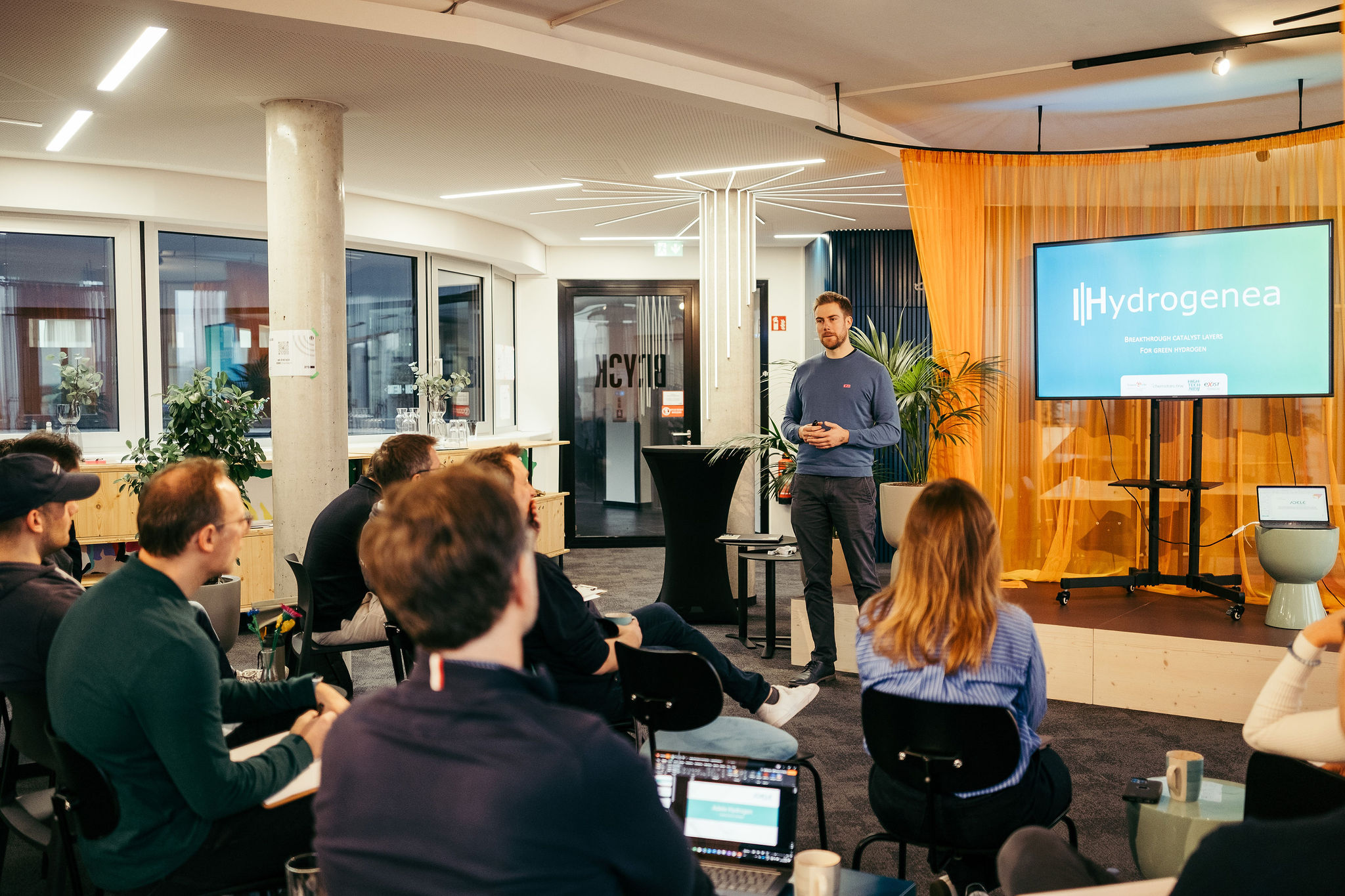
Pit Podleschny: We are a deep-tech hardware start-up in the Ruhr area. Direct Matter, formerly Hydrogenea, produces the core component of green hydrogen production: the membrane electrode assembly (MEA) or electrodes. We are already active in the MW area, which are large-scale electrolyzer modules. We do this by means of efficiency and lifetime, and in doing so, we save precious metals.
What inspired you to found a company?
During my bachelor’s degree in mechanical engineering and my PhD in industrial chemistry with a focus on hydrogen, I worked at big companies. One was an automotive car supplier that was quite innovative; the other was a family-owned business where everyone was open-minded and listened to new ideas. However, I experienced both times that the decision-making processes were equally complex. It was difficult to convince them to push new ideas forward.
That’s when I realized: I wanted more responsibility and to be able to make my own decisions to speed up processes. Additionally, I worked on catalyst development during my PhD. The technology worked so well that I filed for a patent and was eager to push my technology into the market so the hydrogen industry can benefit from it.
Three years ago, I met my co-founder Swen and it was a good match. We started the business and so far it works pretty well.
Which market or technology assumption did you need to reconsider in the process?
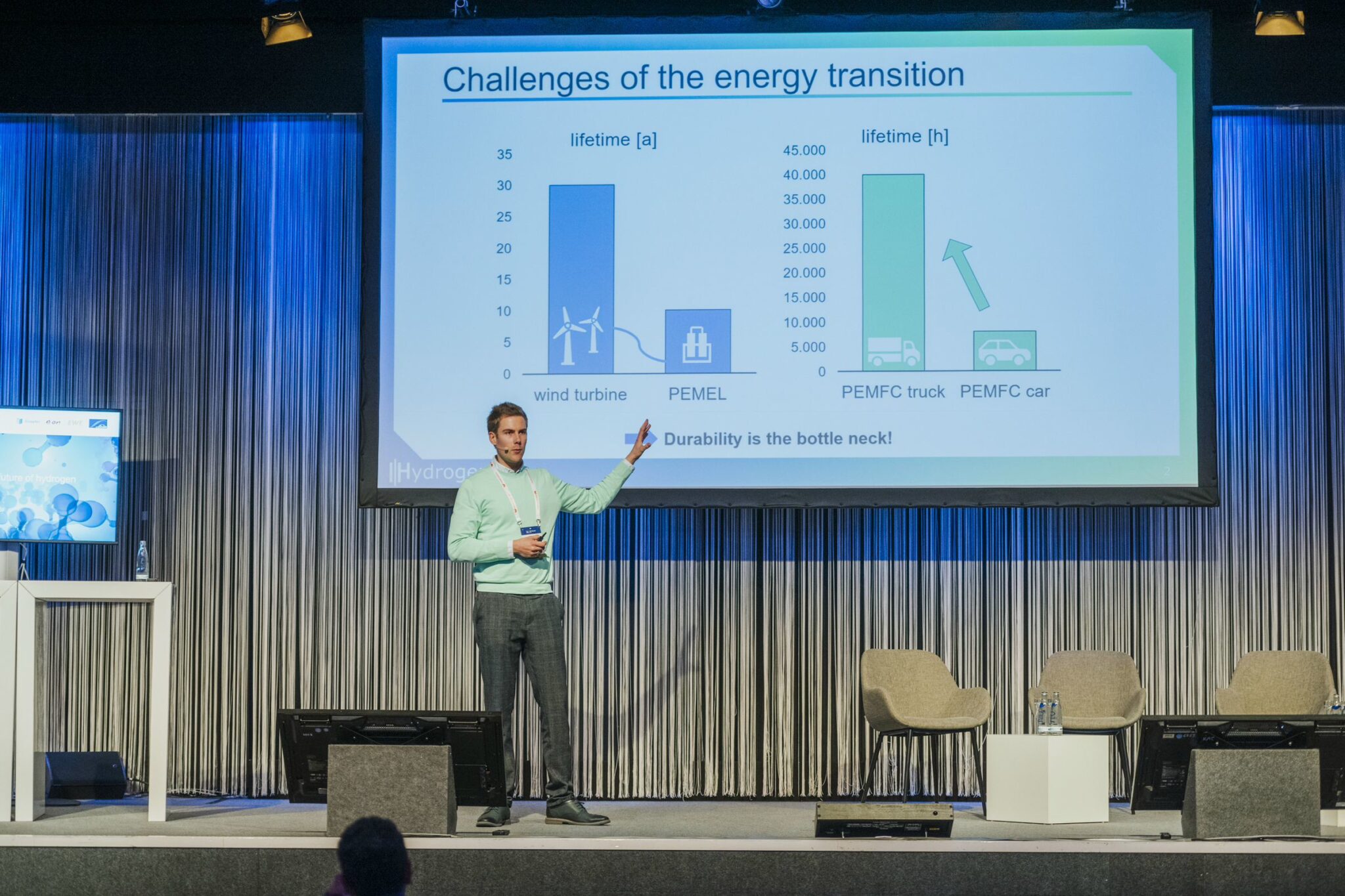
We started in the fuel cell sector, where everyone said higher lifetime was needed. So, we developed a catalyst layer that is 10 times more durable than state of the art. But we learned that while customers want to double or triple the lifetime, they didn’t want to compromise on the performance. This helped us to better understand the market and the client needs.
Another assumption was that success in the PEM market required precious metals like platinum or iridium. So, we developed our technology for cases where they add value, reducing dependency on limited resources.
We also realized that not every application can implement membrane electrode assembly, which was our initial focus. This led us to pivot from Hydrogenea to the rebranding of Direct Matter. Now we also offer entire turnkey electrolyzer systems. For this purpose, we built strong partnerships with an industrial partner. We can implement our core technology into the electrolyzer plant or system of our partners and produce green hydrogen in the most efficient way with it.
What advice would you give other founders who are just starting out?
You need strong partnerships and a great network to benefit from their experience, e.g. in sales processes. As a start-up, you are playing the long game and strong partners are very important for that: They often have an interesting project with the optimal client in tow where your technology can make the difference and you get direct feedback on it.
That’s how we already got in the MW range and became so successful in the market in only two years.
In what ways has participating in the H2UB program positively affected your start-up?
The H2UB has supported us since day one. You were always a sparring partner along the way: How to start the business and establish internal processes, how to convince customers or how to establish serious partnerships. Now, we’re in the phase where we want to increase sales and participate in the large rollout.
Because of the H2UB’s support and work, we were able to evolve from bootstrapping our technology to entering the market to having a small-scale series production, entering MW scale now. We already sold an MW plant for PEM electrolyzers and successfully entered the alkaline market. Thanks to the H2UB, all your partners, players and advisors in your ecosystem, we are now able to tell this success story. It really is a lot of fun to build and expand a company with partners like you who make it so easy.
What was your biggest success since participating?
Scaling our technology. We celebrated many small successes thanks to the H2UB that led us to this point. Joining you at events like the European Hydrogen Week and the H2 Forum gave us visibility, also through stage appearances where we pitched the company. Being a part of the H2UB network is like a certificate: People are more likely to work with you because they know and trust the H2UB.
This connection got many things moving for us. We have this great technology, but the H2UB network is, as we say in German, das Zünglein an der Waage, that means the detail that tips the scale. It helps you succeed in the market, convince people of your technology, and create real momentum in scaling it.
Which part of the accelerator did you find most valuable?
All the small tools that we need day to day like adjusting every pitch deck and pitch to the audience. The events also stood out, especially for meeting other hydrogen enthusiasts the H2UB brought together.
Depending on the phase we were in, the H2UB provided great advice and training. I really liked the hands-on mentality and how everything was customized to our needs. That support helped us succeed in the hydrogen market. It’s always great to work with the H2UB team because you’re so enthusiastic about hydrogen and getting start-ups ready to scale.
Which advice or situation do you remember most vividly?
There are so many, but the three most important ones are
- Be patient: Like I said, it is normal that lead times take 12 months or more.
- Networking is key.
- It’s a process and the process matters: Understanding the market and your current situation, getting and evaluating feedback on each step helps being successful.
What needs to be done to further advance hydrogen and grenn energy innovation in the market?
To really implement innovation in the hydrogen market, we need more final investment decisions that lead to projects advancing the market. The hype phase is over which is great because it was all talks without action which damaged hydrogen’s reputation. Now it’s about real business cases that can produce hydrogen competitively. Still, people are cautious. They worry whether new technologies will work in a decade. But to move forward, people need to trust the technology now.
Politics and bureaucracy are another obstacle. Especially in Germany and Europe. We need to think more pragmatically. Like in Asia where they just do it and learn along the way. We have the technology and competency but we are still hitting the break. We cannot do that any longer. We need to move these obstacles and doubts aside.
Thus, companies, industries and start-ups need political support and incentives to install green hydrogen plants and get certification easily. Otherwise, as we’ve seen with photovoltaics, wind, and batteries, production will move to Asia. Although European politicians say that this won’t happen again, the right signals to avoid this are missing. Strong competitors in Asia are already scaling up rapidly, if Europe wants to lead the hydrogen economy, the time to act is now.
What are your next big steps?
We have already two PEM plants up and running and another big client in the MW scale. That’s the market where Bosch and Siemens Energy operate and where we want to establish ourselves. We’re already in small-scale series production and now we aim to achieve this in the MW scale, becoming an established player known for strong technology and reliable partnerships.
At the end of 2025, we expanded into a new electrolysis market segment. Within just two weeks, we successfully scaled our technology from lab-scale samples, smaller than a DIN A4 sheet, to MW scale implementation with our first paying customer. Our next major milestone is the establishment of full scale serial production.
About Direct Matter
Direct Matter is a German deep-tech company developing and manufacturing advanced membrane electrode assemblies (MEAs) and catalyst layers for electrolyzers and fuel cells. Through innovative coating technologies and optimized catalyst design, Direct Matter reduces the use of critical raw materials while improving the cost, scalability, and sustainability of green hydrogen production
About Pit Podleschny
Dr. Pit Yannik Podleschny is the Co-Founder and CEO of Direct Matter. After years of research in fuel cells and electrolysis technologies, he co-founded the company to transfer scientific breakthroughs into industrial applications. Under his leadership, Direct Matter has rapidly scaled from research projects and prototype development to commercial hydrogen solutions, helping to reduce critical material usage and accelerate the transition to a competitive green hydrogen economy