The global electrolyzer supplier landscape could look fundamentally different in 2026.
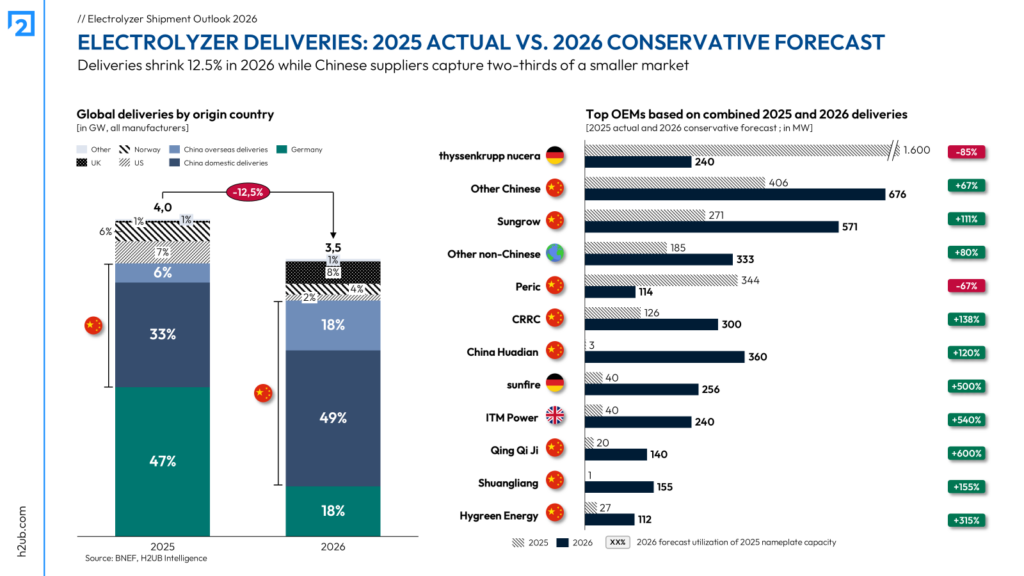
BNEF’s conservative forecast expects total deliveries to decline by 12.5%, from around 4.0 GW in 2025 to 3.5 GW in 2026. Yet within this smaller market, Chinese suppliers are set to expand their share dramatically. Their combined contribution could rise from 39% to 67% of global deliveries, while Germany falls from 47% to 18%. Most strikingly, Chinese overseas deliveries could triple their share of the global market from 6% to 18%. China is therefore not simply defending its dominant domestic position. Its manufacturers are increasingly taking that position abroad.
The manufacturer rankings underline how substantial this transition could be. Thyssenkrupp Nucera, the clear market leader in 2025 with 1.6 GW of deliveries, is forecast to fall to around 240 MW as exceptional volumes from projects such as NEOM run out. Sungrow could more than double deliveries to 571 MW and become the largest individual supplier, while China Huadian rises from almost no deliveries to 360 MW and CRRC reaches 300 MW. At the same time, Sunfire and ITM Power are also forecast to grow strongly, while established Chinese supplier Peric falls by 67%. The picture is therefore more nuanced than simply “China wins, Europe loses”: market shares are being redistributed both between regions and among manufacturers within China itself.
One explanation for China’s international push lies in the economics of its domestic market. Excess manufacturing capacity exists globally, including in Europe, but China combines a much larger manufacturing base with particularly intense internal competition. This has put significant pressure on profitability. BNEF estimates that gross margins for large Chinese alkaline manufacturers declined from around 25% in 2023 to roughly 10% in 2025. The IEA similarly describes surplus capacity as driving unsustainable competition and notes that Chinese manufacturers are expanding overseas to secure additional business.
Their cost position gives them a powerful tool to do so. Benchmark alkaline system costs stand at around $536/kW in China compared with approximately $2,385/kW in Europe, making European systems roughly 4.4 times more expensive. Local EPC and integration costs reduce this gap when Chinese equipment is deployed abroad, but Chinese OEMs still enter international tenders from a substantially lower equipment cost base.
What this means
The key shift is that competitive dynamics previously concentrated inside China are becoming global. Chinese OEMs are increasingly setting the price benchmark in international markets, forcing European suppliers to demonstrate why customers should pay a premium.
Technology alone may not provide a lasting answer. Chinese alkaline systems increased nominal efficiency from 65.9% in 2023 to 72.1% in 2025, matching BNEF’s Western alkaline benchmark. Differentiation therefore increasingly needs to come from measurable lifetime value through durability, guarantees, flexibility, integration, service and reduced project risk.
For the wider innovation ecosystem, this also shifts where value can be created. Technologies improving materials, degradation, power electronics, balance of plant, monitoring and system integration become more relevant as basic equipment faces stronger price competition.
China’s rising export share is therefore not just changing supplier rankings. It is exporting the competitive pressure of the Chinese market to the rest of the world.

For deeper insights get in touch with Alessandro Benassi:
alessandro.benassi@h2ub.com