
When the EU introduced CBAM in 2023, the objective was clear: protect European industry from carbon leakage by placing a carbon cost on imported emissions intensive goods.
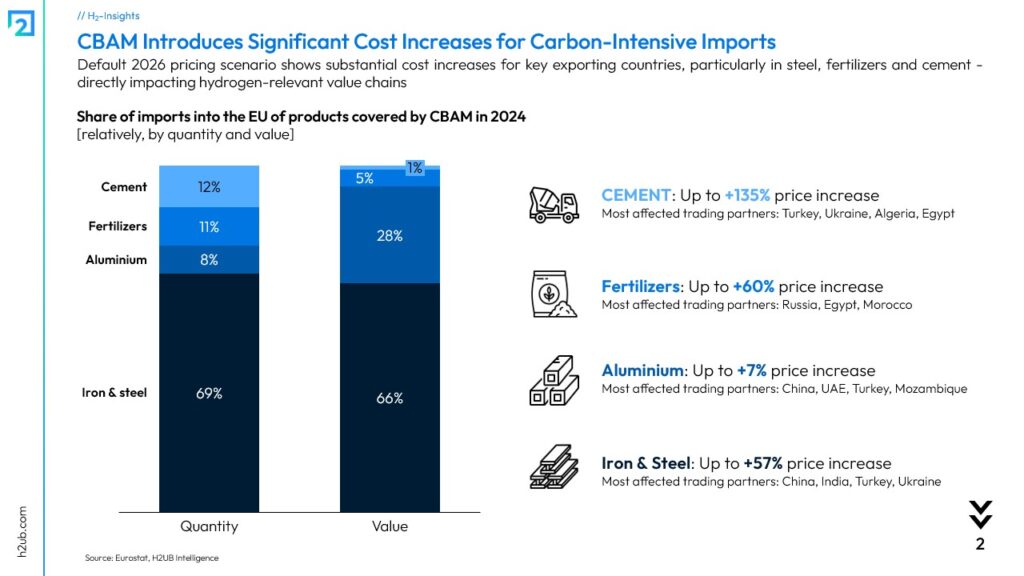
After the initial attention, the debate quieted down. Now it is back. The reason is simple: since early 2026, CBAM has moved beyond reporting and become financially relevant. Importers of products such as steel, cement, aluminum, fertilizers, and electricity must now buy CBAM certificates based on embedded emissions, priced in line with the EU ETS. Carbon intensity has therefore become a direct cost factor for imports. Iron and steel alone account for around 66 to 69 % of CBAM covered imports, underlining the scale of exposure in key industrial value chains.
At the same time, CBAM is already facing political pressure. Debates around indirect emissions, broader sector coverage, and possible exemptions are gaining momentum. Recent calls from France and other EU member states to pause CBAM for fertilizers show how quickly industrial cost pressure can trigger political pushback and how critical implementation credibility will be. This is particularly relevant as early pricing scenarios point to substantial cost increases.
In selected high exposure cases, specific country and sub-product combinations could see cost increases of up to +135 % for cement, +60 % for fertilizers, and around +57 % for iron and steel. In absolute terms, this can translate into additional costs of more than €100 per ton for cement, around €300 per ton for certain steel imports, and roughly €140 per ton for selected aluminum products.
For hydrogen, CBAM matters less directly than strategically. Hydrogen is not yet at the center of the mechanism, but CBAM targets exactly those sectors where low carbon hydrogen is expected to play a major role in decarbonization, including steel, ammonia and fertilizers, refining, and basic chemicals.
As high carbon imports become more expensive, competitiveness, investment logic, and offtake structures may gradually shift in favor of low carbon production. That should improve the business case for green hydrogen, even if the scale of the effect remains uncertain. Much will depend on how consistently CBAM is implemented and whether it is paired with targeted support for hydrogen.
H2UB Perspective: Two Scenarios
We see two plausible development paths:
- Positive scenario – CBAM as an investment anchor
If regulation remains strict, indirect emissions are fully considered, and enforcement is consistent, CBAM can have a strong effect. Carbon intensive imports lose competitiveness, European low carbon production gains, and hydrogen becomes a core element of industrial procurement and risk strategies. CBAM acts as a credible investment signal. - Realisitic scenario – stabilization without boom
More likely, CBAM will evolve pragmatically, with gradual adjustments and political balancing. In this case, hydrogen gains relevance in specific value chains, emissions data becomes a market access requirement, and investment conditions improve moderately but remain sensitive to regulatory changes. No demand boom, but a structural shift toward compliance driven business models.
Conclusion
From our perspective, CBAM is not a standalone trigger for hydrogen demand, but a mechanism that can materially strengthen the business case for low carbon industrial production. The debate is moving beyond sustainability, signaling toward viability under real carbon cost pressure.
For companies in the hydrogen ecosystem, competitiveness will increasingly depend on more than cost alone. Robust MRV, credible emissions data, regulatory resilience and reliable offtake structures will become strategic differentiators. CBAM is not a demand instrument. It is a test of how credibly Europe is prepared to defend its industrial decarbonization pathway.

For deeper insights get in touch with Alessandro Benassi:
alessandro.benassi@h2ub.com